Can a landlord evict you without a gas safety certificate?
Direct answer
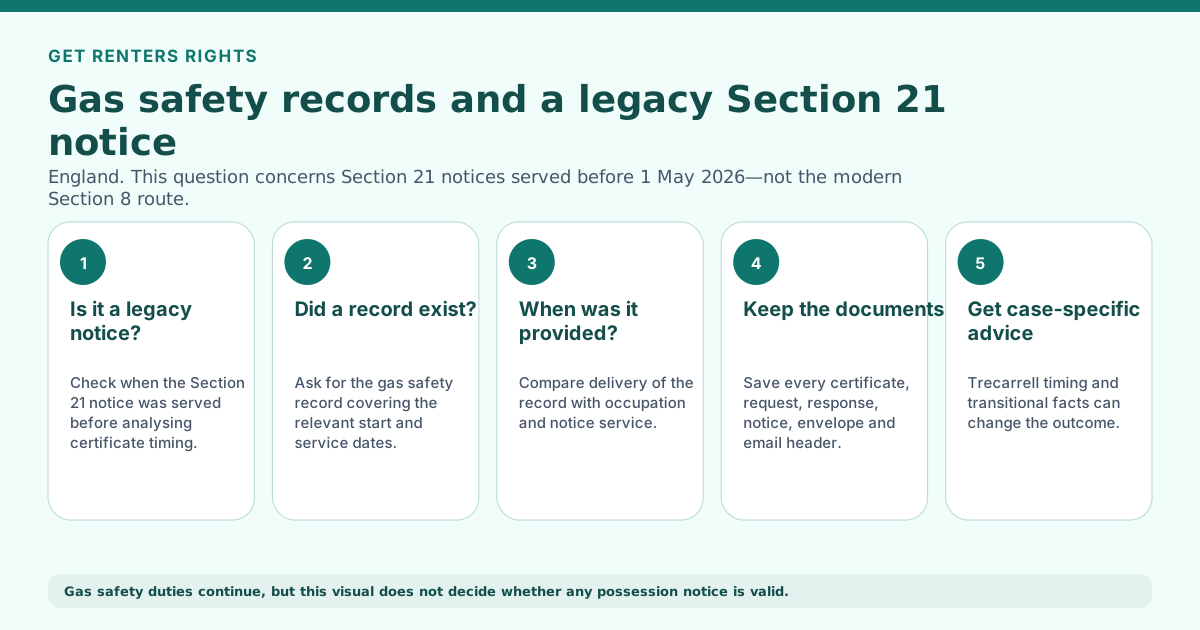
A landlord usually cannot rely on a legacy Section 21 notice if the required gas safety record was not given before the notice was served. The key facts are whether a valid record existed, when it was given to you, and whether the notice was served before the post-2026 Section 21 route closed.
Last updated: 18 August 2026.
What is the legal basis? The Assured Shorthold Tenancy Notices and Prescribed Requirements (England) Regulations 2015, regulation 2, links Section 21 validity to regulation 36 of the Gas Safety (Installation and Use) Regulations 1998.
How does the gas certificate defect work? First ask whether a valid gas safety record existed before you moved in. Regulation 36 requires an annual gas safety check and requires the record to be given to a new tenant before occupation.
If a valid record existed, Trecarrell House v Rouncefield [2020] EWCA Civ 760 means late provision can sometimes cure the issue for a later Section 21 notice, but the record must have existed and been given before that notice was served. Sending it only after the Section 21 notice normally does not fix that notice.
If no valid record existed for a check that should have occurred, Trecarrell does not by itself answer every consequence. Distinguish a record that existed but was given late from a safety check or record that never existed, and obtain advice on the precise chronology before treating the defect as curable or permanent.
From 1 May 2026, new Section 21 notices are abolished entirely. The gas certificate issue only matters for legacy Section 21 notices served before that date.
How can I check the records? Write to the landlord or agent requesting copies of all gas safety records since the start of your tenancy. Regulation 36 contains record-delivery deadlines tied to the check and new occupation; it does not create a universal 28-day response deadline for a later document request. Missing records or proof of delivery should be raised as evidence, not treated as a concluded defect without the chronology.
Source references: Gas Safety (Installation and Use) Regulations 1998 regulation 36, Prescribed Requirements Regulations 2015 regulation 2, and the Court of Appeal judgment in Trecarrell House Ltd v Rouncefield.
Related guidance inside this topic
- If your next step turns on legacy Section 21 notice rules, read Section 21 notice checker.
- For the dates, forms, and evidence behind legacy Section 21 notice rules, see Section 21 notice validity outcome guides before you respond.
- If this issue overlaps with legacy Section 21 notice rules, check deposit amount and property address prescribed information to compare the legal tests.
- For a fuller breakdown of legacy Section 21 notice rules, use late deposit protection Section 21 guide for the underlying rule set.
- If you need the route-specific rules on landlord repair duties, start with landlord repair obligations guide so you can check the dates and documents against your own case.
Sources used for this guide
These are primary legislation and public guidance sources that support the legal-information framework used on this page.
- Housing Act 1988
Primary statute for assured tenancies, Section 8 possession notices, Schedule 2 grounds, and legacy Section 21 rules. - Deregulation Act 2015
Primary statute for several legacy Section 21 restrictions, including prescribed requirements and retaliatory eviction protections. - GOV.UK: private renting evictions
Government guidance on eviction notices, court orders, bailiffs, and tenant rights in private renting. - Shelter England: eviction
Independent housing charity guidance on eviction notices, court claims, and urgent help for renters in England.
Related articles
- Tenant rights in England: complete guide
The main overview page linking eviction, repairs, deposit protection, rent increases, and illegal eviction rights together. - Renter questions answered
Plain-English answers to the most-asked questions from private renters in England: eviction, deposits, rent increases, repairs, illegal eviction, and pets. - Tenant checklist England 2026
A stage-by-stage checklist for issues before move-in, during the tenancy, and at move-out. - Deposit protection prescribed information rules
How the 30-day protection rules, prescribed information, deductions, penalty claims, and Section 21 impact work. - Section 21 abolished: what happens now?
The transition guide for pre-cutoff notices, the 1 May 2026 changeover, and when possession analysis switches to Section 8.
Common questions
- Does a landlord need a gas safety certificate to evict me?
- For a legacy Section 21 notice, yes. The Assured Shorthold Tenancy Notices and Prescribed Requirements (England) Regulations 2015 require compliance with the gas safety record rules before a valid Section 21 notice can be served. If the required gas safety record was missing, the notice may be defective.
- What if my landlord gave me the gas safety certificate after serving the Section 21?
- Late provision after the Section 21 notice is usually a problem for that notice. Trecarrell House v Rouncefield held that an earlier delivery failure can be cured for Section 21 purposes if the relevant gas safety record is given before the notice. It did not decide every disputed inspection-history scenario.
- Is this issue relevant after 1 May 2026?
- The Section 21 gas-record gateway is relevant only to a legacy Section 21 notice served before 1 May 2026. For an ordinary private assured tenancy, Section 8 is now the usual landlord possession route; other occupation types can follow different rules. Gas-safety duties remain important independently of possession.
- What records should I ask the landlord for?
- Ask for the gas safety records covering the relevant period, especially the record the landlord says was given before the Section 21 notice. Keep the request and any response as evidence.
Use the interactive checker on getrentersrights.com for the full step-by-step result.